
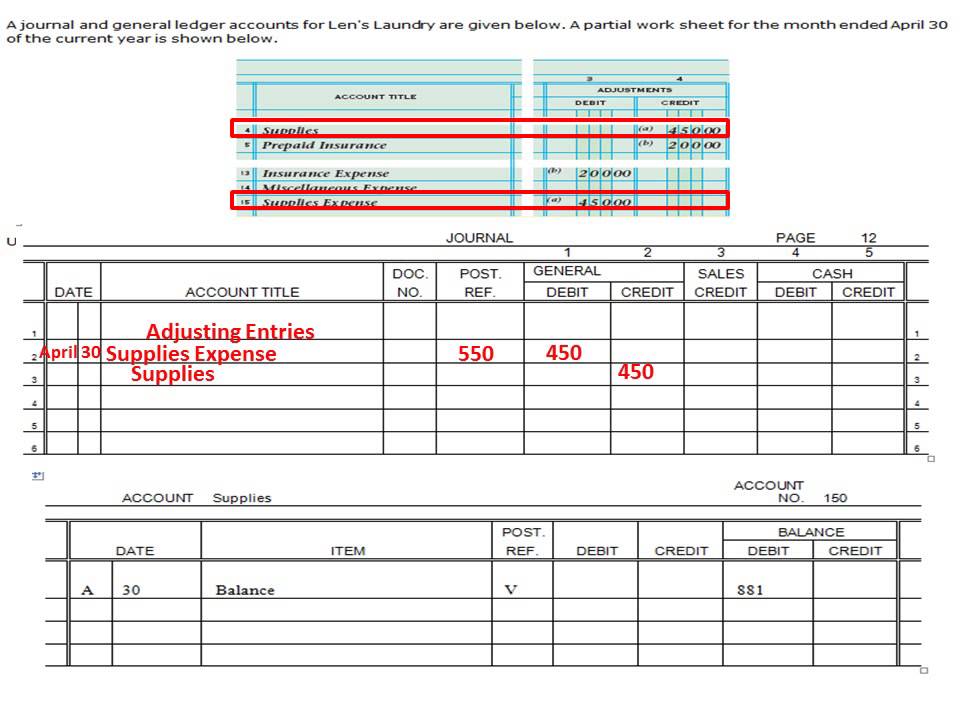
An adjustment involves making a correct record of a transaction that has not been recorded or that has been entered in an incomplete or wrong way. If the Final Accounts are to be prepared correctly, these must be dealt with properly. In all the examples in this article, we shall assume that the adjusting entries are made at the end of each month. In this article, we shall first discuss the purpose of adjusting entries and then explain the method of their preparation with the help of some examples.
Deferred revenues
We at Deskera offer an intuitive, easy-to-use accounting software you can access from any device with an internet connection. You rent a new space for your tote manufacturing business, and decide to pre-pay a year’s worth of rent in December. My Accounting Course is a world-class educational resource developed by experts to simplify accounting, finance, & investment analysis topics, so students and professionals can learn and propel their careers. Shaun Conrad is a Certified Public Accountant and CPA exam expert with a passion for teaching. After almost a decade of experience in public accounting, he created MyAccountingCourse.com to help people learn accounting & finance, pass the CPA exam, and start their career. 11 Financial is a registered investment adviser located in Lufkin, Texas.
Understanding Labor Costs: Types, Calculation, and Financial Impact
When cash is received it’s recorded as a liability since it hasn’t been earned yet by the business. Over time, this liability is turned into revenue until it’s fully earned. The other deferral in accounting is the deferred revenue, which is an adjusting entry that converts liabilities to revenue. A crucial online payments step of the accounting cycle is making adjusting entries at the end of each accounting period. Liabilities also include amounts received in advance for a future sale or for a future service to be performed. You can earn our Adjusting Entries Certificate of Achievement when you join PRO Plus.
Introduction to Adjusting Journal Entries
- Assets depreciate by some amount every month as soon as it is purchased.
- Depreciation is the process of assigning a cost of an asset, such as a building or piece of equipment over the economic or serviceable life of that asset.
- To record accumulated depreciation, an adjusting entry is made to increase the accumulated depreciation account and decrease the corresponding asset account.
- Closing entries relate exclusively with the capital side of the balance sheet.
- Some transactions may be missing from the records and others may not have been recorded properly.
To help you master this topic and earn your certificate, you will also receive lifetime access to our premium adjusting entries materials. These include our visual tutorial, flashcards, cheat sheet, quick tests, quick test with coaching, and more. By making these adjustments, companies can ensure that their financial statements are accurate and reliable, which is important for making business decisions and meeting regulatory requirements. However, mistakes can happen, and it is crucial to avoid them to ensure accurate financial statements. First, record the income on the books for January as deferred revenue.
Depreciation
The amount of insurance premiums that have not yet expired should be reported in the current asset account Prepaid Insurance. Accountants also use the term “accrual” or state that they must “accrue” when discussing revenues that fit the first scenario. Further the company has the right to the interest earned and will need to list that as an asset on its balance sheet. This is posted to the Unearned Revenue T-account on the debit side (left side). You will notice there is already a credit balance in this account from the January 9 customer payment. The $600 debit is subtracted from the $4,000 credit to get a final balance of $3,400 (credit).
When the revenues are earned they will be moved from the balance sheet account to revenues on the income statement. With an adjusting entry, the amount of change occurring during the period is recorded. Similarly for unearned revenues, the company would record how much of the revenue was earned during the period. Adjusting entries affect financial statements by ensuring that they accurately reflect a company’s financial position. This can have serious consequences for a company’s financial health and reputation.

In this sense, the company owes the customers a good or service and must record the liability in the current period until the goods or services are provided. Uncollected revenue is revenue that is earned during a period but not collected during that period. Such revenues are recorded by making an adjusting entry at the end of the accounting period. A liability account that reports amounts received in advance of providing goods or services. When the goods or services are provided, this account balance is decreased and a revenue account is increased.
By making adjusting entries, a portion of revenue is assigned to the accounting period in which it is earned, and a portion of expenses is assigned to the accounting period in which it is incurred. An adjusting entry is an entry made to assign the right amount of revenue and expenses to each accounting period. It updates previously recorded journal entries so that the financial statements at the end of the year are accurate and up-to-date. One of the main financial statements (along with the balance sheet, the statement of cash flows, and the statement of stockholders’ equity). The income statement is also referred to as the profit and loss statement, P&L, statement of income, and the statement of operations. The income statement reports the revenues, gains, expenses, losses, net income and other totals for the period of time shown in the heading of the statement.
You will notice there is already a debit balance in this account from the January 20 employee salary expense. The $1,500 debit is added to the $3,600 debit to get a final balance of $5,100 (debit). This is posted to the Salaries Payable T-account on the credit side (right side).
For example, a company that has a fiscal year ending Dec. 31 takes out a loan from the bank on Dec. 1. The terms of the loan indicate that interest payments are to be made every three months. In this case, the company’s first interest payment is to be made on March 1. However, the company still needs to accrue interest expenses for the months of December, January, and February. Any service performed in one month but billed in the next month would have adjusting entry showing the revenue in the month you performed the service. Not adjusting entries for one month leads to an inaccurate quarterly report.
It looks like you just follow the rules and all of the numbers come out 100 percent correct on all financial statements. Just the fact that you have to make estimates in some cases, such as depreciation estimating residual value and useful life, tells you that numbers will not be 100 percent correct unless the accountant has ESP. Some companies engage in something called earnings management, where they follow the rules of accounting mostly but they stretch the truth a little to make it look like they are more profitable. Others leave assets on the books instead of expensing them when they should to decrease total expenses and increase profit. Under the accrual basis of accounting, expenses are matched with revenues on the income statement when the expenses expire or title has transferred to the buyer, rather than at the time when expenses are paid. The accounting method under which revenues are recognized on the income statement when they are earned (rather than when the cash is received).
